
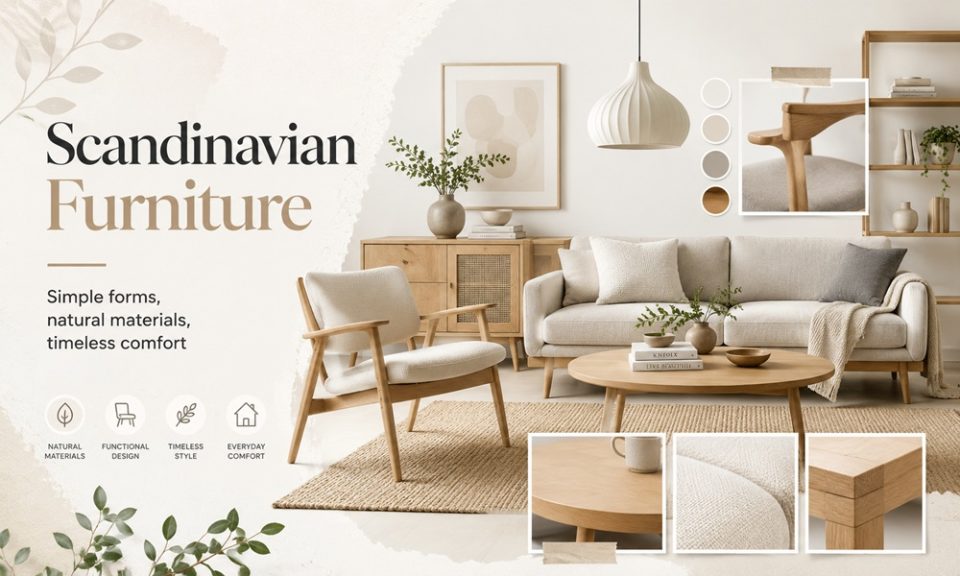
Scandinavian furniture has stayed popular for the better part of a century, and the reason is simple: it makes a home feel calm, bright, and easy to live in. Born in the Nordic countries — Denmark, Sweden, Norway, Finland, and Iceland — the style grew out of long, dark winters and a cultural pull toward warm, functional, light-filled rooms. This guide covers the principles, the materials, the pieces, and how to bring the look into every room.
Quick answer: Scandinavian furniture is defined by clean lines, light natural woods, neutral colours, and function-first design. To get the look, choose light-wood pieces with simple silhouettes, natural upholstery like linen and wool, and multi-functional storage, then keep the palette neutral and clutter-free.
What defines Scandinavian furniture?
A handful of principles show up in almost every Scandinavian piece:
- Simplicity and clean lines — no unnecessary ornamentation.
- Function first — form follows use; every piece earns its place.
- Natural materials — light woods, wool, linen, leather, rattan.
- Neutral, light palette — whites, greys, soft beiges, pale wood.
- Quality craftsmanship — precise joinery, honest construction, made to last.
- Comfort — minimalism that stays warm and inviting, never cold.
Underneath it all is hygge, the Danish idea of cosy contentment, and lagom, the Swedish idea of “just enough.” Together they explain why Scandinavian rooms feel edited but never austere.
Which materials should Scandinavian furniture use?
Material is where the style lives. Reach for these first.
| Material | Where to use it | Why it works |
|---|---|---|
| Light wood (beech, pine, oak, ash) | Frames, legs, tables, floors | Warmth and brightness; the signature look |
| Linen and cotton | Sofas, curtains, cushions | Breathable, natural, relaxed |
| Wool and sheepskin | Throws, rugs, seat pads | Adds hygge warmth and texture |
| Leather | Chairs, straps, accents | Ages beautifully; pairs with blond wood |
| Rattan and cane | Chairs, screens, storage | Light, airy, tactile |
| Wool boucle | Accent chairs, sofas | On-trend texture for curved pieces |
Darker woods like teak and birch appear too, especially in mid-century-leaning pieces, but the default is pale wood that bounces light around the room.
Scandinavian furniture ideas, room by room
Living room
Anchor the room with a low, clean-lined sofa in linen, wool, or leather on slim blond-wood legs. Add a curved boucle accent chair, a light-wood or egg-shaped coffee table, and a wool or sheepskin throw. Keep surfaces clear and let one gallery wall or a single artwork carry the personality.
Dining room
A light-wood dining table with simple tapered legs, paired with iconic Nordic chairs. Add a paper or dome pendant above and a wool runner underfoot. The look is warm, functional, and effortless.
Bedroom
A low wooden bed frame, natural linen bedding, and floating timber nightstands. Layer wool and sheepskin for cosiness. Storage stays built-in or hidden so the room reads serene.
Entryway
This is where function shines. Choose an entryway bench with built-in drawers, shelves, and coat hooks so one piece handles seating and storage. Add a light-wood mirror and a wool runner.
Home office
A simple light-wood desk, a wishbone or moulded chair, floating shelves, and a single plant. Keep cables managed and the desktop clear.
Which iconic Scandinavian pieces are worth knowing?
Part of the fun of the style is its design classics. These pieces defined it and still shape furniture today.
| Piece | Designer / origin | Why it matters |
|---|---|---|
| Wishbone Chair | Hans Wegner (Denmark) | The archetypal Scandi dining chair |
| Egg Chair | Arne Jacobsen (Denmark) | Sculptural mid-century icon |
| Swan Chair | Arne Jacobsen (Denmark) | Curved, soft-modern seating |
| Panton Chair | Verner Panton (Denmark) | The first single-form moulded chair |
| Aalto stool / vase | Alvar Aalto (Finland) | Bent-wood and organic-form pioneer |
You do not need originals. Well-made pieces “in the style of” these classics carry the same clean, functional DNA.
What is trending in Scandinavian furniture now?
The style is evolving rather than being reinvented. The current shifts are subtle:
- Curved and organic silhouettes — soft, plush, rounded sofas and chairs.
- Comfort-forward pieces — deeper seats, poufs, multifunctional daybeds.
- A touch of maximalism — bold wall art and colour accents against neutral bases.
- Vintage mixed with new — a single hard-working vintage piece slotted into a contemporary room, not treated as a museum object.
- Sustainability front and centre — FSC-certified wood, recycled metal, durable natural fabrics.
The through-line: Nordic design now offers something to maximalists and minimalists alike, while holding onto its innate sense of calm.
How do you make a small home feel bigger with Scandinavian furniture?
Multi-functional pieces are the answer, and they are core to the style:
- Nesting tables consolidate into one and expand when needed.
- Storage ottomans give seating, storage, and a surface in one.
- Benches with built-in drawers handle entryway clutter.
- Wall-mounted shelves keep floors clear and draw the eye up.
Add light woods, off-whites, mirrors opposite windows, and plenty of natural light, and even a compact home feels open and airy.
An insight most Scandi guides gloss over
Most articles tell you to buy light wood and keep it minimal, then stop. What they miss is that Scandinavian design is fundamentally a response to darkness. The whole style — the pale woods, the white walls, the light bouncing everywhere — exists because Nordic winters are long and sunlight is scarce. That has a practical takeaway most guides never mention: if you want the look to actually feel Scandinavian and not just clean, you have to design your lighting as carefully as your furniture. Nordic homes famously layer many small, warm light sources — table lamps, candles, a floor lamp, under-shelf strips — rather than relying on one bright ceiling light. So spend on three or four warm lamps before you spend on a fourth accent chair. The furniture gives you the shapes; the layered warm light is what gives you the feeling.
Frequently asked questions
What are the main features of Scandinavian furniture?
Clean lines, light natural woods, neutral colours, natural upholstery, quality craftsmanship, and function-first design that stays comfortable.
What colours are Scandinavian furniture?
Mostly light and neutral — white, grey, beige, and pale wood — with occasional bold accents like mustard, teal, or navy for personality.
Is Scandinavian design the same as minimalism?
It overlaps but is warmer. Pure minimalism can feel cold; Scandinavian design keeps comfort and coziness (hygge) at its core.
What wood is used in Scandinavian furniture?
Light woods such as beech, pine, oak, ash, and spruce, with birch and teak appearing in some mid-century pieces.
How do I make my home look Scandinavian on a budget?
Declutter, add light-wood and natural-fibre pieces, keep the palette neutral, layer warm lamp lighting, and bring in plants. Editing what you own often matters more than buying new.
