
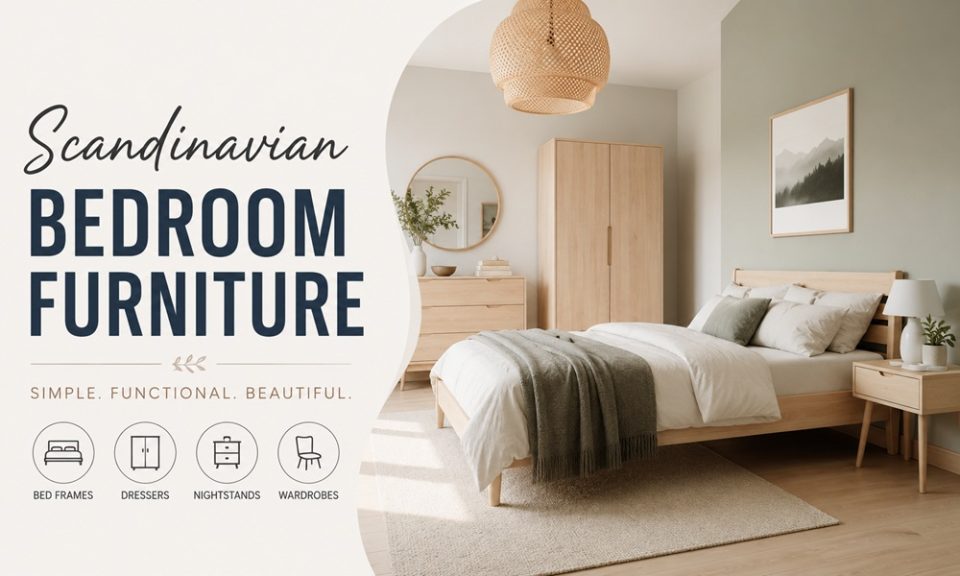
You can paint a room white in a weekend. Furnishing it Scandinavian takes longer, because the style is made of objects, and the objects have rules.
This is a buying guide, organised by piece, in the order you should acquire them. Each section covers what to look for, what dimensions work, which woods, and which historic designs are worth knowing — because the vintage market is where most of the good Scandinavian bedroom furniture still lives.
The Governing Principle
The gentle, organic contours typical of Scandinavian design appear in furniture not as a stylistic gesture, but as a practical, ergonomic and elegant response to the human form.
Every buying decision below runs through one filter: does this piece do a job, and does it show its material honestly?
If the answer is no to either, it isn’t Scandinavian. It’s beige.
The Purchase Order
Buy in this sequence. Each piece unlocks the next.
| # | Piece | Why it comes here |
|---|---|---|
| 1 | Bed frame | Sets the wood tone and the height of the whole room |
| 2 | Nightstands | Fixes function; kills clutter |
| 3 | Lighting | The most important element in a Danish home |
| 4 | Wardrobe or tall storage | Closed storage is the Scandi requirement |
| 5 | Dresser / chest | Second wood tone |
| 6 | Chair | Turns a bedroom into a room |
| 7 | Rug | Grounds it |
| 8 | One vintage piece | Gives it a soul |
Piece 1 — The Bed Frame
What to Look For
- Low profile. Scandinavian beds sit near the floor. It makes ceilings read taller.
- Visible wood grain, natural clear coat. Select pieces that let the natural wood grain shine, with a natural clear coat instead of a heavy or dark stain.
- Slatted base, not a solid platform. It’s how they’ve always been built and it’s better for the mattress.
- Storage underneath, or clear space underneath. Never a skirt.
A low-profile platform bed, optionally with an upholstered frame, gives an effortless, sophisticated look. A bed frame with room under the bed to store clothes, bedding and shoes is a Scandi staple.
Headboard Options, Ranked
| Type | Reads as | Notes |
|---|---|---|
| Slatted or panelled wood | Classic Scandi | Safest choice |
| Cane or rattan weave | Danish mid-century | Cane-woven headboards appear across Børge Mogensen and Wegner-era designs |
| Linen upholstered | Modern, soft | Choose oat or stone, never grey |
| Floating / wall-mounted | Architectural | Frees the frame entirely |
| No headboard | Purist | Requires excellent bedding |
The Historic Reference Points
Worth knowing, because reproductions and originals both circulate:
- Hans J. Wegner’s teak bed frames for GETAMA, with cane headboards
- The Wegner GE 701 double bed in veneered and solid teak, with cane weaving on headboard and footboard
- Børge Mogensen daybeds and single beds in teak for Søborg Møbelfabrik
- Poul M. Volther’s single bed in teak and cane
- Josef Frank’s bed frames in mahogany and cane, produced by Svenskt Tenn
The Feature Almost Nobody Copies Anymore
Attached floating nightstands.
Danish mid-century beds frequently integrated floating nightstands directly into the headboard — platform beds with floating nightstands and concealed storage compartments, or slatted beds with two built-in nightstands attached to the headboard, each with a drawer.
It’s the single most space-efficient bedroom idea Denmark ever produced, and modern manufacturers have largely abandoned it. If you find one, buy it.
Sizing
| Element | Dimension |
|---|---|
| Frame height (top of mattress) | 18″–22″ |
| Headboard height above mattress | 12″–24″ |
| Clearance to each side wall | 24″ minimum, 30″ preferred |
| Clearance at foot | 30″ |
Piece 2 — The Nightstand
The Rule
Drawers, not shelves.
As stylish as bedside shelves look, nothing beats the practicality of a nightstand with drawers. Open shelves display clutter. Scandinavian design hides it.
What to Look For
| Attribute | Target |
|---|---|
| Height | Level with the top of the mattress, ±2″ |
| Width | 16″–20″ |
| Depth | 14″–16″ |
| Legs | Tapered, exposed floor beneath |
| Drawers | One or two |
| Wood | Oak, ash, teak, birch |
Mid-century modern nightstands show iconic tapered legs, natural wood tones and streamlined silhouettes.
Tapered legs and visible floor underneath are not decoration. They add a sense of space and delicacy — a small room reads larger when you can see the floor continue beneath the furniture.
Contemporary Interpretations
Modern Scandinavian bedside tables are built from solid birch with laminated birch veneer, or solid oak with oak veneer — modern yet classic, bold yet modest.
Vintage Reference Points
- Hans Wegner’s floating oak nightstands for Getama, with glass inserts to the top
- Wegner’s oak bedside tables “Model 430” for Ry Møbelfabrik — minimal, typical of his 1960s period
- Kai Kristiansen and Kofod Larsen teak nightstands with drawer and magazine rack
- Westnofa rosewood nightstands from Norway
Piece 3 — Lighting
Lighting isn’t decoration in this style. It’s structural.
Lighting is considered by many Danes to be the most important aspect of a hygge home.
The Fixture Set
| Fixture | Purpose | Spec |
|---|---|---|
| Bedside lamps ×2 | Reading, atmosphere | 2000K–2700K bulb, warm shade |
| Ceiling pendant | Cleaning, general | Dimmable, opal or paper shade |
| Wall sconce (optional) | Frees the nightstand | Swing-arm, brass |
| Floor lamp (optional) | Reading chair | Tapered wood or brass stem |
Meik Wiking’s rule: a ceiling light for when you need to clean, plus two bedside lamps with a warm hue, is sufficient to create a calming atmosphere.
Wall-mounted sconces add modern elegance while freeing valuable nightstand space. For a truly authentic Nordic feel, choose fixtures made from natural materials like wood or rattan.
Materials and Finish
Choose brass over chrome or nickel finishes.
This one instruction changes a room more than any other furniture decision in this article. Chrome reads cold under 2700K light. Brass glows.
The Canonical Designs
- Poul Henningsen’s PH series — a 1958 Scandinavian lighting design; a revolutionary, glare-free composition that remains ever-youthful
- Verner Panton’s Flowerpot — a mid-century icon defined by two semi-circular spheres
- Greta Magnusson Grossman’s Grasshopper series (Sweden)
Piece 4 — Wardrobe and Closed Storage
The Cultural Point Most Guides Miss
Open storage systems remain popular across the United States, but less so in Europe. Most Europeans, especially Scandinavians, are horrified at the idea of busy bookshelves and mismatched clothing hanging out in the open.
The open clothing rail, the exposed shelf of folded jumpers, the visible sweater stack — these are American ideas photographed in Scandinavian rooms.
The Buying Rules
Maximise vertical storage space and minimise the horizontal footprint by choosing the tallest possible closet.
| Attribute | Target |
|---|---|
| Height | Floor to ceiling, or as close as possible |
| Doors | Flat panel, push-to-open or slim recessed pull |
| Interior | Rail + shelves + at least two drawers |
| Wood | Match or contrast the bed, never almost match |
| Handles | Brass, leather, or none |
Under-Bed Storage
Under-the-bed drawers are helpful for storing linens and look neater if they’re already built into the bed frame.
Built-in beats bought-separately. A rolling plastic box under an otherwise beautiful bed undoes the room.
Piece 5 — The Dresser or Chest
This is where you introduce your second wood tone.
If the bed is pale oak, the dresser can be walnut or teak. If the bed is teak, the dresser can be birch or ash.
What to Look For
- Six to eight drawers, low and wide, or three to five, tall and narrow
- Tapered legs, floor visible beneath
- Recessed or sculpted pulls rather than applied hardware
- Solid drawer bottoms and dovetailed joints (the vintage tell)
Vintage Reference
Rosewood campaign-style chests with recessed side handles and metal corner protection are a recurring Scandinavian modern form.
Piece 6 — The Chair
Every Scandinavian bedroom has one chair that isn’t a desk chair.
Add a cozy chair in the corner with a blanket or quilt draped over it. Any place or space for a small ritual that you can return to at the end of the day.
It isn’t a truly cozy nook without a comfortable chair, a warm throw, a soft light source and a small table for a cup of tea.
What Works
| Chair type | Notes |
|---|---|
| Spindle-back / Windsor-style | Light, cheap, disappears visually |
| Woven paper cord seat | The Wegner signature |
| Low lounge chair with wood arms | The luxury option |
| Simple upholstered slipper chair | Safest for small rooms |
A skinny, tapered-legged chair adds a sense of space, delicacy and sturdy Scandinavian structure.
The Designers Worth Knowing
The Danes excelled at chairs. Hans Wegner and Arne Jacobsen were exemplars of the country’s facility with wood, particularly teak. Wegner created the Round chair and the Wishbone chair; Jacobsen produced the plywood Ant chair and designed the Swan and Egg chairs of the 1950s. Finn Juhl was a stylistic maverick and maker of the bold Chieftain chair; Poul Kjærholm worked with a lean metal-and-rattan aesthetic; Verner Panton introduced vibrant colour.
Finland produced Alvar Aalto, a master at melding function and artistic form in works like the Paimio chair, created with his first wife Aino. Sweden was home to Bruno Mathsson, creator of the Berlin daybed.
Piece 7 — The Rug
Mix minimalist wooden pieces with a white, textured rug. A rug with a black-and-white pattern, or a woven weft pattern, also works. Over wooden flooring, jute rugs add texture.
A soft, plush bedside rug bookends your day with calm, cozy moments — and as the weather gets colder, it warms the room.
Two-rug strategy for a bedroom: a large flat-weave or jute rug under the bed (two-thirds of the way up, so it emerges past the nightstands), plus a small high-pile or sheepskin rug on the side you get out of.
Piece 8 — The Vintage Piece
This is what separates a room that looks Scandinavian from a room that is.
Danish design was a huge part of the mid-century era, so if you can include a few original pieces in a hygge-inspired bedroom, it will add character and authenticity.
For a more sustainable option, check second-hand furniture stores for unique, pre-loved wooden pieces.
Names to Search For
| Country | Designers | Makers |
|---|---|---|
| Denmark | Hans J. Wegner, Arne Jacobsen, Børge Mogensen, Finn Juhl, Poul Kjærholm, Verner Panton | GETAMA, Ry Møbler, Søborg Møbelfabrik, Falster Møbelfabrik |
| Sweden | Bruno Mathsson, Greta Magnusson Grossman, Josef Frank, Carl Malmsten | Svenskt Tenn |
| Finland | Alvar and Aino Aalto | Artek |
| Norway | Westnofa | — |
The Historical Anchor
The signature elements that define Nordic style — minimalist white walls, wood floors, modern furniture — took shape in the 1950s with the establishment of The Lunning Prize, awarded annually to eminent Scandinavian designers from 1951 to 1970.
That twenty-year window is the sweet spot for vintage hunting.
Wood Selection Guide
| Wood | Colour | Grain | Period signal | Cost |
|---|---|---|---|---|
| Oak | Pale honey | Prominent | Contemporary + 1960s | ££ |
| White oak | Pale, cool | Straight | Contemporary | ££ |
| Ash | Very pale | Straight, open | Contemporary | ££ |
| Birch | Blond | Fine, subtle | Finnish, plywood | £ |
| Pine | Warm, knotty | Rustic | 1970s Swedish | £ |
| Beech | Pale pink-brown | Tight | Utility pieces | £ |
| Teak | Warm brown, oily | Straight | 1950s–60s Danish | £££ |
| Rosewood | Deep, figured | Dramatic | 1960s luxury | ££££ |
| Walnut | Dark chocolate | Rich | Contemporary contrast | £££ |
Finish note: Some contemporary designers are choosing darker stains on white oak — deep chocolate stains for a rich effect — to make cabinetry feel earthy and substantial without going fully dark. The same logic applies to bedroom furniture: darker-stained oak reads more considered than raw white oak, which has become ubiquitous.
Budget Tiers
| Tier | Bed | Nightstands | Lighting | Approach |
|---|---|---|---|---|
| Entry | Flat-pack birch/pine platform | Flat-pack, add brass pulls | Warm bulbs + paper shade | Buy the bulbs, not the fixtures |
| Middle | Solid oak or ash slat bed | Solid wood, tapered legs | One designer pendant + two lamps | Splurge on the pendant |
| Considered | Vintage teak or contemporary solid oak | Vintage Danish pair | PH-series or equivalent | Vintage first, new to fill gaps |
| Collector | Wegner/Mogensen original | Attached floating pair | Original PH | Buy from dealers with provenance |
The consistently reported best-value move: cheap frame, expensive light, real wool, real linen. Nobody notices your bed frame. Everybody notices the light.
What Do Real Buyers Say?
Themes recurring across Reddit’s r/midcenturymodern, r/InteriorDesign and r/vintagefurniture, plus Quora threads on Danish design and Medium collector essays:
- Teak beds are a bargain relative to teak chairs. Collectors chase seating; beds get overlooked. Full Danish teak bedroom sets often sell for less than a single Wegner chair.
- Cane headboards need maintenance. Rewebbing costs real money. Inspect before buying.
- “IKEA plus brass pulls” is universally endorsed. Swapping hardware on flat-pack furniture is the single most repeated budget tip in the community, and the before/after photos support it.
- Watch out for veneer damage on rosewood. Restoration is specialist work.
- Match the mattress to the frame, not the other way round. Vintage Danish beds use non-standard sizes; custom-cut mattresses are common for restored frames.
- Buy the chair last. People consistently regret buying the statement chair before they have the storage sorted.
