
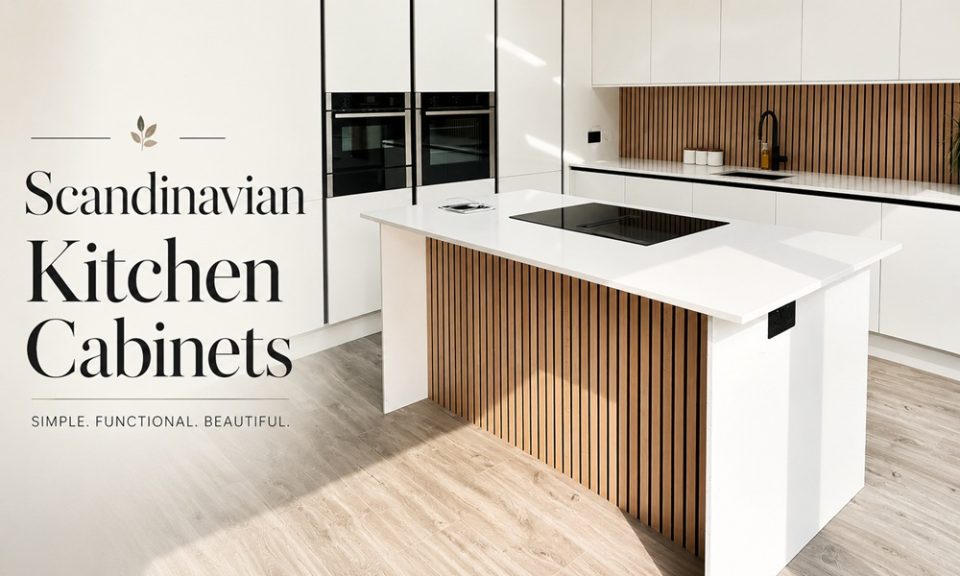
Everything you notice in a Scandinavian kitchen is a cabinet decision.
The door profile. The wood. The absence of handles. The way one run of drawers lines up with the next. Get those four right and the rest of the kitchen follows.
This is a spec sheet, not a mood board. Door styles, materials, hardware, costs, and the details installers argue about.
Which Door Style Should You Choose?
| Door style | What it is | Best for | Watch out for |
|---|---|---|---|
| Slab (flat panel) | A single flat face, no frame | The cleanest, most minimal Nordic look | Cheap finishes show every flaw; nothing to hide behind |
| Slim shaker | Shaker outline with a reduced profile | Scandi calm without full minimalism | A wide shaker rail instantly reads American farmhouse |
| Lightly framed | A thin visible border, not a true face frame | Scandi simplicity with Japanese restraint | Adds cost for a subtle effect |
| Fluted / reeded | Vertical grooves across the face | One accent run or an island | Fluting every door is exhausting; use once |
| Perforated / vent-hole | Decorative airflow cutouts | A single tall unit or larder | A newer detail; check it suits your carcass depth |
Rule of thumb: slab for the perimeter, one textured run for interest. Two door profiles maximum in a single kitchen.
Which Material and Finish Lasts Best?
| Material | Look | Durability | Relative cost |
|---|---|---|---|
| Solid oak / ash | Warm, grain-forward, ages well | Very good; can be sanded and re-oiled | High |
| Oak veneer on MDF/ply | Identical face, more stable | Very good; cannot be re-sanded much | Medium |
| Painted MDF, matte | Crisp, colour-flexible | Good; chips at edges over time | Medium |
| Textured melamine | Convincing wood grain, low upkeep | Excellent for moisture | Low–medium |
| Thermofoil | Budget wood-look | Fine; can delaminate near heat | Low |
| High-gloss acrylic | Reflective, contemporary | Durable but shows every fingerprint | Medium–high |
The Scandi finish rule: matte or satin, never high gloss. Low-sheen coatings keep the wood tactile and stop the door acting as a mirror for your ceiling lights.
Wood tones: light oak, ash and birch remain the classic base. Stained oak and American walnut are the current growth area — recent industry survey data shows a clear majority of professionals reporting increased demand for medium-to-dark wood tones, reversing years of blonde-only kitchens.
Handleless, Finger Pull or Wooden Knob?
| Opening method | How it works | Pros | Cons |
|---|---|---|---|
| True handleless (push-to-open) | Sprung latch, no hardware at all | The cleanest possible line | Costs most; fingerprints on the door face |
| Integrated channel (J-pull / C-channel) | Recessed grip milled into the door or rail | Handleless look, positive grip | Channel collects crumbs; needs wiping |
| Shark-nose / bevelled edge | Angled notch as the grip | Elegant, no protrusions | Sharp on bare shins in a tight galley |
| Finger pull cut-out | A milled hole or slot | Cheap, effective | Only as good as the routing quality |
| Small wooden knob or leather pull | Minimal visible hardware | Warm, tactile, easy for kids and elderly | Reads more rustic than minimal |
Two honest warnings.
Handleless cabinetry typically carries a meaningful premium per linear foot over conventional hardware once the mechanisms are counted.
And matte black or high-gloss white handleless fronts are fingerprint magnets, because your hand touches the door itself. Mid-tone oak and warm matte neutrals hide this best. This is the single most common regret in owner threads.
What Do Scandinavian Kitchen Cabinets Cost?
Prices below are installed, per linear foot of cabinet run (uppers plus lowers along the same wall).
| Tier | Installed cost per linear foot | Typical 10×10 kitchen |
|---|---|---|
| Flat-pack (IKEA-type) | $150 – $300 | $3,000 – $6,500 |
| Stock cabinets | $100 – $400 | $2,000 – $8,000 |
| Semi-custom | $150 – $700 | $5,000 – $16,000 |
| Fully custom | $500 – $1,200 | $15,000 – $30,000+ |
Add-ons that move the number:
- Handleless mechanisms: significant premium per linear foot
- Frameless / full-overlay construction: roughly 20–50% over framed
- Inset doors: can approach double a framed unit, because tolerances are tight
- Panel-ready appliance fronts: extra doors plus extra fitting time
- Internal storage (dividers, pull-outs, recycling): often 10–15% of cabinet cost
Where Nordic kitchens genuinely save money: slab doors have fewer construction steps than shaker, and typically cost around 10–15% less in a comparable material.
IKEA vs Semi-Custom vs Custom: Which Is the Smarter Nordic Kitchen?
| Flat-pack | Semi-custom | Fully custom | |
|---|---|---|---|
| Look | Genuinely Scandinavian by default | Very close, more finish choice | Exactly what you draw |
| Carcass | Engineered wood, long service life | Ply or MDF | Ply, solid wood |
| Sizes | Fixed modules | Adjustable depth and width | Anything |
| Handleless | Available, limited | Available | Fully integrated |
| Lead time | Days to weeks | 4–8 weeks | 8–16 weeks |
| Best for | Tight budgets, standard layouts | Most homeowners | Awkward layouts, seamless runs |
The hybrid that most designers actually recommend: flat-pack carcasses with upgraded custom fronts. You buy Swedish engineering for the box and spend the money where the eye lands.
How Do You Plan the Interior Storage?
Scandinavian kitchens look sparse because the inside works hard.
- Drawers below the worktop, always. Base cabinets with doors waste the back third. Deep drawers give you every cubic inch.
- One tall pantry column beside the fridge, with pull-out shelves.
- Zone by routine, not by object type. Coffee zone. Cleanup zone. Cooking zone. Store what you use together, together.
- Recycling and waste inside a drawer, sorted. Not a bin in the corner.
- Appliance garage for the kettle, toaster and blender. This is what keeps the worktop empty.
- Full-height cabinetry on one wall rather than uppers on three. It reads as a wall, not as storage.
- Cutlery and utensil dividers in wood, not plastic. You will see them daily.
What Colours and Wood Tones Are In?
| Family | Examples | Direction |
|---|---|---|
| Warm neutrals | Chalk, oat, sand, mushroom, greige | Dominant. The overwhelming professional consensus. |
| Light wood | Oak, ash, birch | Timeless Scandi base |
| Dark wood | Stained oak, walnut, smoked oak | Rising sharply; Japandi crossover |
| Muted colour | Sage, olive, soft yellow, clay | Accent runs and islands |
| Cool grey | Any blue-based grey | Declining fast |
| High gloss | Lacquer, acrylic | Declining; matte is the majority preference |
Two-tone works, but subtly. Light upper cabinets with a deeper lower run is still popular. The contrast is getting quieter — oat over mushroom, not white over navy.
The Detail That Separates Expensive From Cheap
Reveals.
The reveal is the gap between adjacent doors and drawers. Scandinavian kitchens look expensive when that gap is identical everywhere — typically 3 mm — and when horizontal lines run unbroken across the fridge panel, the drawer bank and the pantry door.
Three things you can insist on with any installer:
- Consistent reveals across the entire run, checked with a spacer, not by eye
- Aligned horizontals: drawer lines continue across appliance panels
- A scribed plinth that follows the floor’s real level, with no light gap beneath
None of this costs extra material. It costs care. Ask about it before you sign.
How Do You Care for Scandinavian Cabinets?
- Matte painted: a damp microfibre cloth, mild soap, never a scouring pad. Touch-up paint in the same batch, kept labelled.
- Oiled wood: re-oil once a year, more often near the sink. It is a fifteen-minute job.
- Lacquered veneer: wipe spills quickly; standing water lifts veneer edges.
- Handleless fronts: wipe the opening zone weekly. Skin oil is the real enemy, not dirt.
- Melamine and thermofoil: keep steam away from the front edge near dishwashers. Fit a steam deflector strip.
Mistakes to Avoid
- Choosing gloss because the showroom lighting flattered it. Showrooms are lit to sell gloss.
- Handleless doors in matte black with young children. You will wipe them daily.
- Doors below the worktop. Drawers cost slightly more and are twice as useful.
- Three wood tones in one room. One hero, one supporting, maximum.
- Cheap slab doors. Slab has nowhere to hide a bad finish. If the budget is tight, choose slim shaker.
- Forgetting the reveal conversation. It is the difference between a Nordic kitchen and a flat-pack kitchen.
Frequently Asked Questions
What is the best cabinet colour for a Scandinavian kitchen? A warm white or light oak base, with one muted accent. Warm neutrals are the strongest current direction across the industry.
Are slab cabinets cheaper than shaker? Usually, yes — typically around 10–15% less in a comparable material, because there are fewer construction steps. But a slab door demands a better finish to look right.
Do Scandinavian kitchens use upper cabinets? Sparingly. The preferred move is full-height storage on one wall and open wall space elsewhere, which is what creates the bright, uncluttered feel.
Is IKEA a legitimate Scandinavian kitchen? Yes. The engineering, module logic and finish options are authentically Nordic. Many designers upgrade only the door fronts and keep the carcasses.
Are handleless cabinets practical for families? Practical, yes. Low-maintenance, no. Expect fingerprints on the door face, and choose a mid-tone matte or wood finish rather than black or white.
How long do these cabinets last? Engineered wood carcasses commonly last 25–30 years with normal use. Fronts usually date before they fail — which is a strong argument for a plain, quiet door style.
